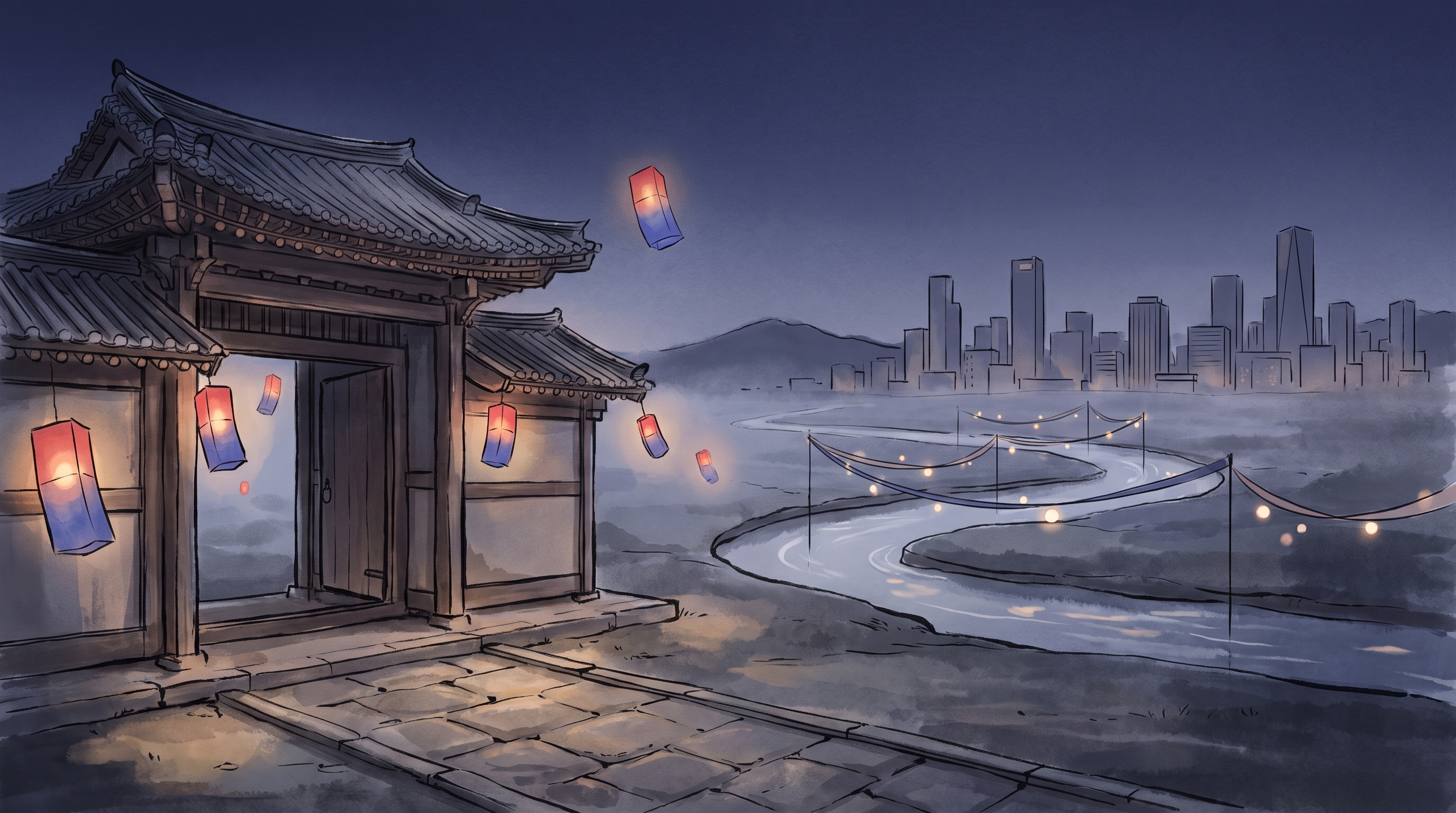
Seoul rearranges itself after sunset. A palace courtyard that belongs to day-trippers becomes a slow procession of paper lanterns on a handful of scheduled nights. A working government building keeps a rooftop open to anyone who walks in, late into Friday and Saturday evenings. And in a residential district south of the river, a narrow stream becomes an outdoor gallery of commissioned light installations in the coldest months. Three settings, three tempos, one city. Here is what each evening actually involves, and how the pieces fit together.
Why Seoul feels different after sunset
The appeal of an evening itinerary here is not simply cooler air. It is that the city's registers separate out. Changdeokgung, a UNESCO World Heritage Site, opens for a nighttime program built around Korean palace culture rather than sightseeing volume. The Seoul City Hall Sky Observatory, which opened in July 2026, offers a panorama in which the modern skyline and older architecture sit in the same frame. Gwanak Starlight Walk, a signature winter festival in Gwanak-gu, lines the Byeolbitnaerincheon Stream with light art on a neighborhood scale.
Practically, they behave very differently. One is ticketed, dated and language-specific. One is free and needs no planning beyond checking the clock. One is seasonal and belongs to a different part of the calendar entirely. Knowing which is which saves an evening from collapsing into transit.
Lanterns at Changdeokgung: what the Moonlight Tour covers
The Changdeokgung Palace Moonlight Tour is a guided walk, not a free-roaming night opening. Participants are accompanied by a guide while carrying traditional red-and-blue Korean lanterns, which sets the pace immediately: you move as a group, in low light, at conversational speed.
The route strings together places that reward being seen at night. It passes Geumcheongyo Bridge, the oldest bridge in Seoul, and Injeongjeon Hall, where foreign envoys were once welcomed. The tour continues with a daegeum performance at Sangnyangjeong Pavilion and a stop for commemorative photos at Buyongji Pond, then ends at Yeongyeongdang, a space once used for banquets, where participants have traditional refreshments while listening to traditional music. The whole program runs approximately 100 minutes at the palace, located at 99 Yulgok-ro, Jongno-gu.
Booking a foreign-language session this autumn
Sessions reserved for foreign visitors were scheduled across four dates: September 20 and 27, and October 4 and 11, 2026. Start times are staggered by language, with English sessions at 19:20, 20:00, 20:05 and 20:10, a Japanese session at 19:10 and a Chinese session at 19:15. Reservations opened on a first-come, first-served basis from 09:00 on August 28 through the Korean travel platform Creatrip.
Two caveats matter for anyone reading in late September. Because the dates are fixed and capacity is limited, availability changes without notice — nothing here should be read as a promise that seats remain. Ticket cost is also not something we can state, so confirm the price and any conditions at the point of booking rather than budgeting from assumption.
A free panorama: Seoul City Hall Sky Observatory at dusk
For an evening view with no booking friction, the Sky Observatory occupies the 8th and 9th floors of the west wing of the Seoul City Hall main building and gives a 360-degree outlook. Looking south, the sightlines take in Deoksugung Palace, Jeongdong Street, Seoul Plaza and Sungnyemun Gate; to the north, Gwanghwamun Plaza and the ridge of Bugaksan Mountain. Inside are the Sky Plaza Café, a gallery and rest areas. Admission is free and no reservation is required.
Timing is the only real constraint. Opening hours run 07:30 to 18:00 Monday through Thursday, extending to 22:00 on Friday and Saturday, with Sundays closed — so a genuinely dark-sky visit means a weekend evening. Access is via an elevator on the 1st floor of Seoul City Hall at 110 Sejong-daero, Jung-gu, directly connected to Exit 5 of City Hall Station on Subway Lines 1 and 2.
Light art along Byeolbitnaerincheon Stream
Gwanak Starlight Walk works at the opposite scale from a palace or a tower. The event area spans 300 meters from Sillimgyo Bridge to Bongnimgyo Bridge, at 1642-7 Sillim-dong in Gwanak-gu, following a stream through everyday streets rather than a monument district.
The installations are commissioned work: lighting artworks by ten different Korean artist teams, presented with hands-on programs during the festival period. It is a winter festival, not an autumn one, so treat it as a later entry in the calendar — and note that specific dates and nightly hours for the coming edition are not something we can confirm here, which makes a check with the district's own announcements worthwhile before travelling across the city.
Stitching an evening together
The arithmetic is simple once the fixed points are visible. A palace session beginning between 19:10 and 20:10 and running about 100 minutes will absorb the whole evening; pairing it with anything else is optimistic. A late observatory visit only exists on Friday and Saturday, when doors stay open to 22:00, and its position at City Hall Station makes it an easy hinge between daytime plans and dinner in the Jeongdong area.
The stream walk asks for its own trip. Three hundred meters is short by design — closer to an unhurried loop than a destination — and it sits in a different season and a different part of the city from the other two. The most useful habit, in a city where nighttime programs are dated, ticketed and weather-dependent, is to confirm the current schedule shortly before you go and keep one flexible hour in reserve.
Korea Tourism Organization · Korea Tourism Organization en